PROFESSIONAL TRAINING PROGRAM - CHAMP
Certified Hardware Asset Management Professional.
Maximize Asset Value. Optimize Every Hardware Investment.
Limited Batch • 20% Discount
₹36,000
Next Executive Cohort Starts in 6 Days
- Official CITAMP Proctored Exam Voucher Included
- 2 Included Exam Retake Attempts (Zero surcharge)
- Mock Tests to Ace the Exam in One Go!
- AI-Driven Job Interview Prep Simulator
- Lifetime Certification Validity • No Renewal Fee
Duration
90 Days
Level
Intermediate
Mode
Live Online/Classroom
Language
English/Hindi
Course Overview
What you will get in this training
Certified Hardware Asset Management Professional (HAM Pro) training by OptimITnow helps you build practical knowledge of ServiceNow Hardware Asset Management and manage hardware assets throughout their lifecycle. Learn how to maintain trustworthy asset data, manage hardware models, and understand the relationship between assets and Configuration Items (CIs). Explore inventory and stockroom management, procurement, asset transfers, audits, and retirement processes. Understand how HAM Pro workflows help automate asset lifecycle activities and improve operational efficiency. Gain insights into hardware model normalization, CMDB integration, dashboards, reporting, and asset data accuracy.
This training helps you develop the skills to support better hardware visibility, cost control, compliance, and asset management decisions.
Key Learning Outcomes
By the end of this training, participants will be able to
Key Learning Outcomes
- Understand hardware assets from procurement and deployment to maintenance and retirement.
- Understand asset records, Configuration Items (CIs), data accuracy, and normalization.
- Learn the fundamentals of tracking hardware inventory, stock, and asset transfers.
- Explore lifecycle automation and hardware asset management processes.
- Understand asset audits, data integrity, and compliance-supporting practices.
- Learn how asset dashboards and reports support monitoring and decision-making.
- Understand how accurate asset tracking and lifecycle controls can help reduce waste and improve asset utilization.
Course Curriculum
A structured learning path to build practical skills in CHAMP.
1
Module 1: Introduction to Hardware Asset Management
HAM fundamentals, business value, asset categories and lifecycle overview.
Overview
Understand the fundamentals of Hardware Asset Management (HAM), its business value, and its role in managing IT hardware throughout its lifecycle. Learn how structured asset management improves visibility, accountability, utilization, and cost control.
Learning Focus
Build a strong foundation in HAM principles, organizational requirements, and industry best practices.
- Understand HAM concepts, objectives, scope, and business benefits.
- Identify hardware asset categories, including laptops, desktops, servers, network devices, and peripherals.
- Understand the end-to-end hardware asset lifecycle.
- Learn the roles and responsibilities of ITAM, procurement, finance, and IT operations teams.
- Understand the relationship between HAM, IT Service Management (ITSM), and Configuration Management.
- Identify common HAM challenges and opportunities for improvement.
2
Module 2: Hardware Asset Management Policies & Governance
Policies, ownership, standards, controls and performance indicators.
Overview
Learn how to establish effective HAM policies, procedures, ownership structures, and controls that support consistent asset management across the organization.
Learning Focus
Develop the governance framework required to manage hardware assets effectively and maintain reliable asset records.
- Understand HAM policies, standards, and operating procedures.
- Define asset ownership, accountability, and stakeholder responsibilities.
- Establish hardware asset management processes and controls.
- Understand asset classification, tagging conventions, and identification standards.
- Define asset handling, usage, assignment, and transfer procedures.
- Learn how to establish KPIs and measure HAM process effectiveness.
3
Module 3: Hardware Procurement, Receiving & Deployment
Purchasing, receiving, verification, tagging and asset assignment.
Overview
Explore the processes involved in hardware demand planning, purchasing, receiving, verification, tagging, and deployment. Understand how effective procurement controls support accurate inventory and cost-effective asset acquisition.
Learning Focus
Build practical knowledge of hardware acquisition and the controls required to maintain asset traceability from purchase to deployment.
- Understand hardware demand planning and procurement workflows.
- Review purchase requisitions, purchase orders, and vendor coordination.
- Verify received assets against purchase orders and delivery documentation.
- Learn asset tagging, serial number capture, and initial registration.
- Understand asset assignment, allocation, and deployment procedures.
- Maintain procurement documentation, warranties, and supporting records.
4
Module 4: Hardware Inventory, Asset Tracking & Data Management
Inventory accuracy, reconciliation, asset records and data quality.
Overview
Learn how to maintain accurate hardware inventory records and track assets across locations, departments, users, and operational environments. Understand the importance of data quality, reconciliation, and asset visibility.
Learning Focus
Develop the skills required to maintain reliable hardware asset data and improve inventory accuracy.
- Maintain hardware asset registers and inventory records.
- Understand asset identification using serial numbers, asset tags, and model details.
- Track asset location, ownership, status, and assignment.
- Perform physical inventory verification and reconciliation.
- Identify duplicate, missing, unrecorded, and incorrectly assigned assets.
- Understand asset normalization and the relationship between assets and configuration items (CIs)
- Maintain accurate and auditable asset documentation.
5
Module 5: Hardware Asset Lifecycle & Maintenance Management
Maintenance, warranties, transfers, utilization and hardware refresh.
Overview
Explore how hardware assets are managed from deployment through operational use, maintenance, refresh, transfer, and replacement. Learn how lifecycle controls help extend asset value and improve operational efficiency.
Learning Focus
Understand how to manage assets consistently throughout their useful life while reducing downtime, waste, and unnecessary expenditure.
- Understand the stages of the hardware asset lifecycle.
- Manage asset assignment, transfers, returns, and reassignment.
- Track warranty coverage, maintenance agreements, and support contracts.
- Manage repairs, replacements, defective equipment, and return merchandise authorization (RMA).
- Monitor asset utilization, age, condition, and refresh requirements.
- Understand asset reservations, loaner devices, and employee onboarding/offboarding.
- Establish lifecycle controls and procedures for asset status changes.
6
Module 6: IHardware Asset Financial Management, Risk & Compliance
TCO, depreciation, risk controls, audits and cost optimization.
Overview
Learn how to control hardware expenditure, evaluate asset-related financial information, identify operational risks, and prepare for audits. Understand how effective HAM processes contribute to governance and informed business decisions.
Learning Focus
Build the knowledge required to improve financial visibility, reduce asset-related risks, and support compliance requirements.
- Understand hardware acquisition costs, maintenance costs, and total cost of ownership (TCO).
- Learn asset depreciation fundamentals and financial record reconciliation.
- Identify underutilized, redundant, lost, and unaccounted-for assets.
- Understand warranty, contract, security, and operational risks.
- Prepare asset documentation and evidence for internal and external audits.
- Monitor compliance with organizational policies and asset management procedures.
- Identify opportunities to reduce costs through reuse, redeployment, and lifecycle optimization.
7
Module 7: Hardware Retirement, Disposal, Reporting & Practical Assessment
Secure disposal, lifecycle closure, reporting and final assessment.
Overview
Learn how to retire hardware assets responsibly, maintain complete disposal records, and generate meaningful reports for management. Apply the concepts covered throughout the course to practical hardware asset management scenarios.
Learning Focus
Consolidate your knowledge through lifecycle closure, reporting, process improvement, and a final assessment.
- Understand hardware retirement and decommissioning procedures.
- Manage asset disposal, resale, donation, and recycling workflows.
- Follow data sanitization and secure disposal requirements appropriate to the device and organizational policy.
- Update asset records and financial documentation following retirement.
- Develop inventory, lifecycle, utilization, and compliance reports.
- Identify HAM performance indicators and opportunities for continuous improvement.
- Complete practical exercises, knowledge checks, mock tests, and a final assessment.
TARGET AUDIENCE
Who Should Enroll in This Course?
Improve hardware asset visibility, lifecycle control, and resource utilization.
Optimize hardware purchasing decisions and manage supplier relationships effectively.
Control hardware expenditure, manage asset costs, and support budget planning.
Streamline hardware deployment, maintenance, tracking, and retirement.
Plan hardware requirements and ensure assets are available for project delivery.
Support business continuity through effective hardware availability and replacement planning.
Practical Learning
Hands-on Labs & Practical Exercises
Reinforce your learning through guided labs, practical assignments, and real-world hardware asset management scenarios. Develop hands-on skills in hardware inventory, asset lifecycle management, compliance, reporting, and cost optimization.
Practice creating and maintaining hardware asset records, capturing serial numbers, asset tags, device specifications, ownership, and location details to improve inventory accuracy.
Work through practical business scenarios involving missing assets, duplicate records, unassigned devices, inventory discrepancies, and hardware tracking challenges.
Learn how to identify, classify, validate, and standardize hardware asset data to improve data quality, asset visibility, and reporting accuracy.
Practice managing hardware procurement, receiving, deployment, assignment, maintenance, transfers, refresh, and retirement throughout the asset lifecycle.
Explore asset audit preparation, warranty tracking, lifecycle costs, hardware utilization, risk identification, and opportunities to reduce unnecessary IT expenditure.
Apply your knowledge through practical exercises involving inventory reconciliation, asset utilization reports, lifecycle analysis, audit documentation, and hardware asset management case studies.
Our Leadership
Our Experts at a OptimITnow
Meet the experts driving innovation, delivering results, and shaping the future of IT Asset Management, Cloud, AI, and technology solutions.
AMAR DEEP KUMAR
ITAM Technical & Solution Architect
IT Asset Management Solution Architect
Result-oriented IAITAM Certified IT Asset Manager, ServiceNow and Flexera Certified SAM Operations Consultant, and PRINCE2® Practitioner with 20+ years of experience across MIS, HAM, SAM, IT Asset & Configuration Management, Procurement, and SAP Software License Compliance & Governance.
Tools: Flexera FNMS/Data Platform, ServiceNow SAM Pro, ServiceNow, CA IT Asset Manager, HP Asset Manager, and Advanced Excel.
Vineet sharma
SAM : Flexera / Flexera on Architect
Software Asset Management Solution Architect for Flexera One
Result-oriented Flexera Certified SAM Solution Architect with 20+ years of experience in IT Asset Management, Software Asset Management (SAM), and software license compliance and governance. Experienced as a Flexera One SAM Solution Consultant and IT Asset Management Solution Architect, delivering SAM strategy, solution design, implementation, optimization, compliance, and governance initiatives.
Tools: Flexera One / FNMS and Advanced Excel.
Nitesh Kumar
Enterprise AI Architect | ML Specialist
Enterprise AI Architect | Edge Intelligence & Deep Learning, ML Specialist
As an AI & ML Domain Expert with over 12 years of professional experience , I specialize in transforming advanced, cutting-edge AI research into highly optimized, real-world production systems. My career spans impactful roles at top-tier global technology leaders and institutions, including Qualcomm, Samsung Research, NCS Singapore, DMU UK and NTU Singapore
Expertise: Deep Learning, Audio/Speech AI, Computer Vision, Transformers, and Edge Intelligence.
CERTIFICATION & ASSESSMENT
Certification & Assessment
Validate your expertise through structured assessments and strengthen your knowledge of Hardware Asset Management (HAM) with practical learning, certification preparation, and performance evaluation.
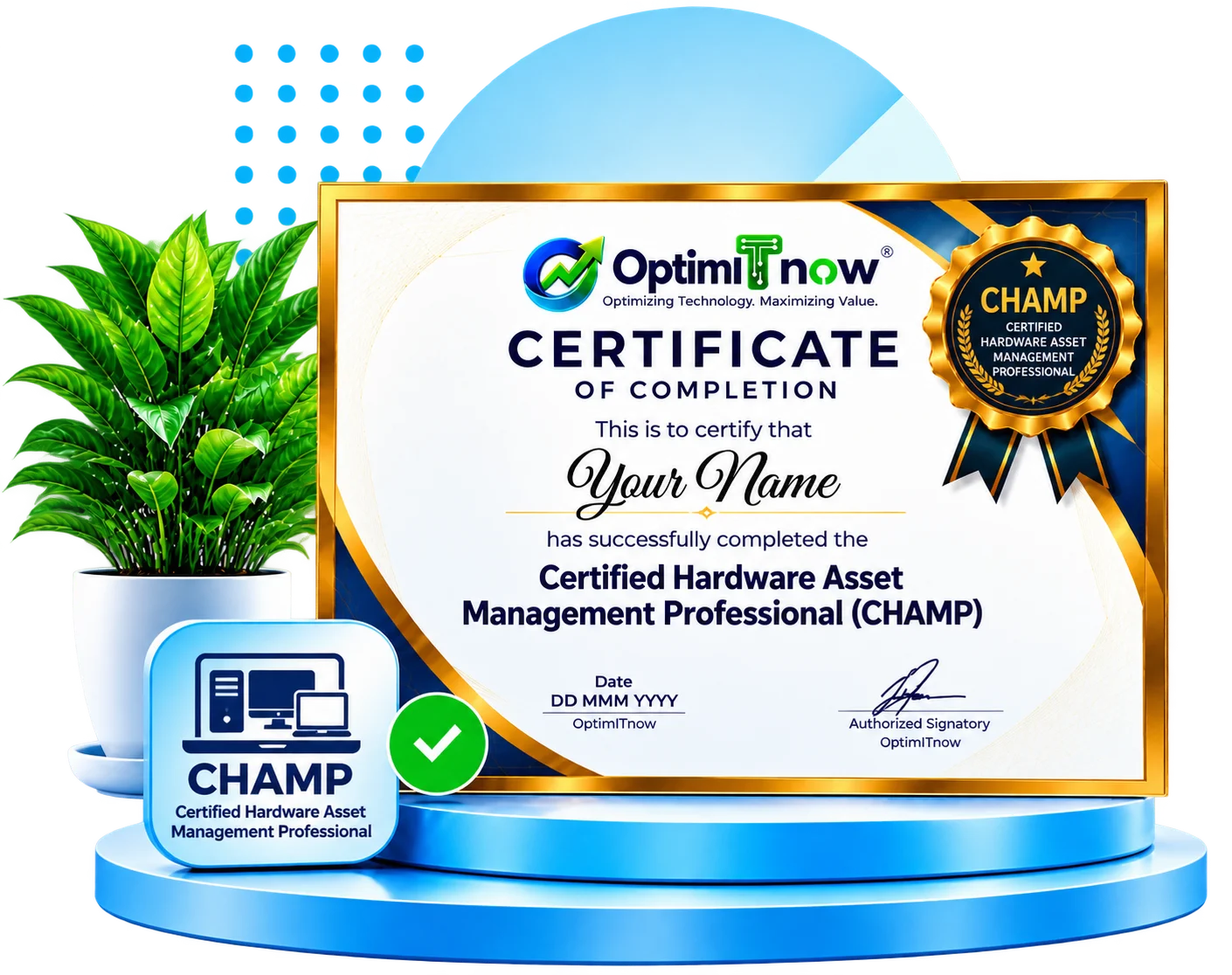
Receive an OptimITnow Course Completion Certificate upon successfully completing the CHAMP training program and meeting the course completion requirements.
Build your hardware asset management expertise with guidance on key HAM concepts, asset lifecycle management, inventory control, IT asset tracking, compliance, and industry best practices.
Evaluate your knowledge through chapter-wise quizzes, practical exercises, and a final assessment designed to reinforce learning and demonstrate your understanding of hardware asset management principles.
CAREER OPPORTUNITIES
Build a Rewarding Career
with CHAMP
COURSE FAQs
Frequently Asked Questions
Find answers about our Certified Hardware Asset Management Professional training, certification and assessments.
How Do I Register?
Register Your Interest by clicking on this link: Register Now
Who is the ideal audience for the CHAMP Certification?
This Certification includes IT asset managers, IT service managers, IT procurement managers, IT finance managers, IT operations managers, and anyone else responsible for managing IT assets and IT services in an organization.
What are the job prospects for CHAMP Certification?
The job prospects for individuals with CHAMP Certification are quite promising, as organizations are increasingly recognizing the importance of effective IT asset management in achieving their business goals. Job opportunities for IT asset managers, IT service managers, IT procurement managers, IT finance managers, and IT operations managers are expected to grow in the coming years.
What is the relevance of CHAMP Certification in the Industry?
The Certified Hardware Asset Professional (CHAMP) certification holds significant relevance in the industry, particularly in sectors where IT infrastructure and hardware management are critical to business operations. Here are several reasons why this certification is important:
1. Growing Demand for Hardware Asset Management
- Increased reliance on technology: As businesses and organizations rely more heavily on technology, the need to manage and maintain physical hardware (servers, desktops, laptops, networking equipment, etc.) effectively becomes more crucial.
- Lifecycle management: Companies need professionals who can oversee the lifecycle of hardware assets—starting from procurement, through maintenance, to disposal. With the rapid pace of technological change, effective hardware asset management ensures that hardware is utilized efficiently and effectively.
2. Cost Savings and Efficiency
- Optimizing resource utilization: Effective hardware asset management helps prevent over-purchasing, underutilization, or unnecessary asset wastage. By optimizing the usage and deployment of hardware, companies can reduce costs.
- Maximizing asset lifespan: A CHAMP-certified professional can ensure that hardware assets are well-maintained, extending their lifespan and reducing the need for costly replacements or repairs.
3. Risk Mitigation and Compliance
- Security and compliance: Hardware assets are often subject to regulatory standards (e.g., data protection laws, environmental regulations for e-waste disposal). A certified professional ensures that all compliance requirements are met and that the organization’s hardware management practices align with legal and regulatory frameworks.
- Data security: Proper hardware asset management reduces the risk of data breaches, as sensitive data can be securely wiped from old devices before they are disposed of or repurposed.
4. Standardization and Best Practices
- Industry standards: CHAMP certification provides a deep understanding of industry best practices for asset tracking, auditing, and lifecycle management. This standardization helps improve the overall efficiency of an organization’s IT and asset management functions.
- Frameworks like ITIL: The certification also emphasizes frameworks such as ITIL (Information Technology Infrastructure Library), which are widely adopted for optimizing IT service management and aligning hardware management with business goals.
Conclusion:
In summary, the CHAMP Certification is highly relevant in the current industry landscape due to its focus on optimizing hardware asset management, driving cost savings, mitigating risks, ensuring compliance, and supporting sustainability efforts. It is a credential that helps professionals excel in an increasingly technology-dependent world while offering organizations the expertise needed to manage hardware assets effectively and efficiently.
How long is CHAMP Certification valid for?
With ITAM EduTech certifications, you only need to obtain them once, as they have a lifetime validity and do not require renewal or any renewal fees.
Student testimonials
Real Student Stories.
Here from our student about their journey, growth and what makes OptimITnow a great place to work.
Let's build what next
Ready to Transfer Your IT Infrastructure?
We specializes in ITAM (HAM, SAM, Licensing) and extends into Data Engineering, Machine Learning, Generative and Agentic AI, cloud FinOps, cybersecurity, and training & Certification to drive compliance, efficiency, and innovation.
No Obligation, No Cost, Just Clarity.